

Build to hold
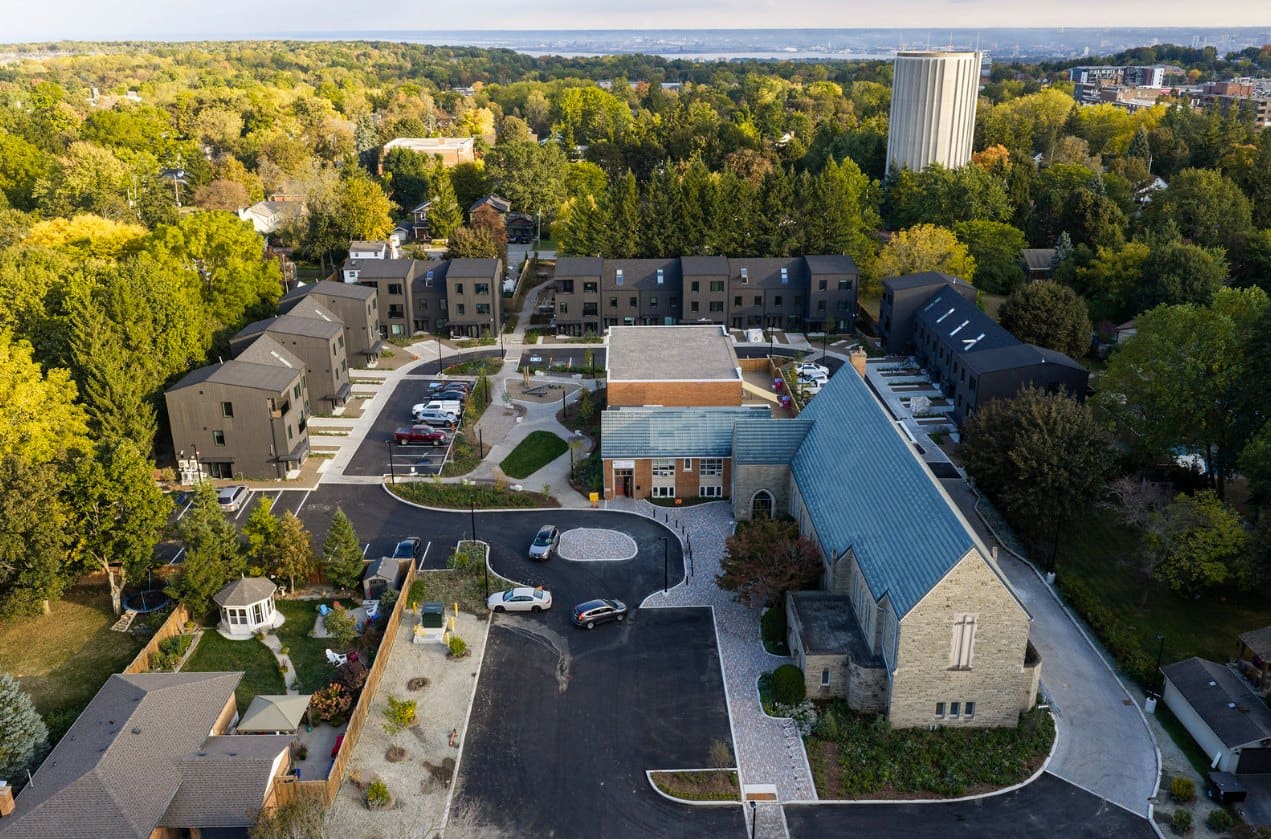
Pension plans, endowments and other large institutions have long built real asset portfolios. Many favour a Build-to-Hold approach: developing new buildings with the explicit aim of holding them as long-duration, income-producing core assets.
New buildings are designed to current standards for energy performance and climate resilience. They need less capital spending than older stock and, we believe, perform better over the long term.
Heartwood Residential Growth Trust applies this model at a scale open to accredited investors, with an existing pipeline of 14 projects and approximately 2,580 units.
“Buildings that start now are expected to be delivered and leased after much of the current wave has been absorbed.”
Why private rental housing
Purpose-built rental housing is a long-duration real asset. Demand is driven by the basic need for shelter, and it pairs recurring rental income with the potential for long-term capital appreciation.
It also has trade-offs investors should weigh: limited liquidity, less frequent valuation and dependence on the manager to execute its strategy.
Why now
Six trends point to the current period as an opportunity for new rental supply.
A structural shortage. CMHC estimates Canada needs up to 470,000 new homes a year over the next decade, or 4.7 million by 2036. At current delivery trends, that implies a shortfall of roughly 2.4 million units.
Population growth is returning to the cities. After a pause of about two years, as federal changes reduced non-permanent resident inflows, population growth is projected to normalize at roughly 0.8 to 1.0% a year by 2030, in line with the long-term average of about 1.0% (1991 to 2021). Because that growth is concentrated in major cities, where land is scarcest, it adds most directly to demand for purpose-built rental.
Renting is rising. Between 2011 and 2025, renter households in Canada grew by about 1.4 million (35%), against 22% growth in total households. The renter share rose from 30.6% to about 33.9%, and is forecast to reach about 35.6% over the next decade. In the Greater Toronto and Hamilton Area, owning a new 631 sq. ft. condo costs on average about $1,338 a month more than renting one.
Competing supply is fading. In 2025, 28 condominium projects in the GTHA totalling 7,243 units were cancelled. Condo starts fell about 63% to 3,272 units, down more than 88% over three years. As fewer investor-owned condos are built, secondary rental supply is expected to shrink and purpose-built rental is expected to carry more of the load.
Supply is peaking. A surge in completions from 2024 to 2026, together with slower population growth, has moderated rent growth and lifted Toronto purpose-built vacancy to 3.0% in 2025. We believe this is a cyclical adjustment, not a change in fundamentals, and national vacancy is forecast to fall toward about 2% by 2030. Buildings that start now are expected to be delivered and leased after much of the current wave has been absorbed. The Trust’s first two properties are expected to stabilize in Q1 2027, and over a third of projects across the existing pipeline are expected to be stabilized by 2030.
Construction costs have eased, offsetting higher interest rates. Costs have come down from their recent peak, which we believe offsets much of the effect of higher interest rates on project economics since 2022. The Trust uses fixed-price or other risk-managed construction contracts to hold costs once a project starts.
Why growth
To capture that window, the Trust takes part in development through a Build-to-Hold strategy focused on new, climate-safe, purpose-built rental housing. It moves through four stages.
Entitlement. Sites are assembled, and municipal approvals and zoning are generally secured before the Trust commits capital to a project.
Construction. Buildings are developed to institutional standards, using fixed-price or other risk-managed construction contracts intended to limit cost overruns.
Lease-up and stabilization. Completed buildings are leased toward stabilized occupancy and recurring income.
Long-term ownership. Stabilized buildings are generally kept as core income-producing assets rather than sold.
The Trust targets 20 to 30% of its units at below-market rents. This is a strategic choice, not a social one. It gives the Trust access to lower-cost government financing and other public programs, and reduces risk by supporting early lease-up and stable occupancy in new buildings.
We expect a flight to quality. When renters have more choice, as they do while record completions are absorbed, they tend to favour new, energy-efficient, well-designed buildings over older stock. That supports faster lease-up and stronger retention.
The Trust is capped at approximately $2 billion in assets under management, which it intends to reach by developing its existing pipeline. After that, development is limited, and the portfolio is expected to shift toward mostly stabilized, income-producing buildings. We project that these new buildings, financed with lower-cost debt, operating efficiently and leasing at market rents, can earn higher returns than older stock once stabilized.
Public incentives that favour new rental
Governments at every level are using incentives to speed up new rental supply. We believe this is a defining feature of the current window. The main programs are:
Low-cost, government-supported debt. Projects are intended to be financed through CMHC-insured loans, which offer lower interest rates than conventional financing. We believe this financing is achievable for projects that meet program requirements, including high energy performance, which is a core design target for the Trust’s buildings.
Development charge relief. Municipal development charge reductions or rebates can reach up to 50% on some projects.
Realty tax relief. Municipal property tax relief may be available on qualifying affordable and rental projects.
GST/HST relief. Federal and provincial relief on new rental construction is estimated to reduce project costs by 8 to 10%.
Seed funding. The Trust has $40 million of interest-free seed funding from CMHC’s Affordable Housing Innovation Fund, forgivable if the required units are delivered by January 2034. It lowers the Trust’s cost of capital.
Free-market rents as an inflation hedge
In Ontario, units first occupied for residential purposes after November 2018 are generally exempt from the annual rent increase guideline, so market-rate rents can be reset in line with market conditions. We believe this makes the income stream a natural hedge against inflation.
If new supply contracts later in the decade, as projected, we also believe rent growth could exceed inflation.
Tax features that support long-term growth
The Trust is not expected to make regular cash distributions until certain initial properties stabilize. In a non-registered account, return is expected to build as unit value and is generally not taxed until units are redeemed, when one-half of the capital gain is included in income.
Once distributions begin, any amount above the Trust’s taxable income is treated as a return of capital. That reduces the investor’s cost base and defers tax.
New buildings add a further benefit. Eligible new purpose-built rental projects that began construction after April 15, 2024, are completed before 2031 and are available for use before 2036 may claim a 10% capital cost allowance on Class 1, up from the standard 4%. The higher allowance lowers taxable income relative to cash flow, which should reduce the income allocated to unitholders and increase the share of distributions treated as return of capital, deferring tax.
This is where Build-to-Hold matters. The accelerated allowance applies only to new construction, so owners of existing buildings cannot claim it. By developing its own buildings and then holding them, the Trust is positioned to claim the allowance itself through the years it is most valuable. Because recapture generally arises only on a sale, a long-term hold can defer it indefinitely.
Provided the Trust continues to qualify as a mutual fund trust, units are intended to be qualified investments for RRSPs, RRIFs, DPSPs, RESPs, RDSPs, TFSAs and FHSAs, which can shelter growth further.